A properly installed gutter system is one of the smartest investments you can make in your home’s long-term protection and value.
The difference between a gutter system that performs reliably for decades and one that causes problems within a few years almost always comes down to installation quality. Gutters that are installed with incorrect pitch, insufficient hanger spacing, poorly sealed joints, or inadequate downspout sizing will underperform from day one, and no amount of cleaning or repair will fully compensate for a system that was not set up correctly at the start.
At Marietta Gutter Company, our gutter installation service covers everything from initial site assessment and material selection through final fitting, sealing, and flow testing. Whether you are building a new home, replacing a gutter system that has reached the end of its service life, or upgrading to a different material or profile to better suit your property, we bring the same careful, methodical approach to every installation. We work with a full range of gutter materials including copper, galvanized steel, PVC, seamless metal, and wood, so you are never limited to a single option regardless of your home’s style, your budget, or your performance expectations. Fill out our estimate form today and let us help you find the right system for your home.
Request Your Free Gutter Installation Estimate
Whether you are replacing a failed system, installing gutters on a new addition, or upgrading to a material better suited to your home and your goals, getting an accurate estimate is the right first step. Installation costs vary based on the linear footage of guttering required, the number of stories, the material selected, the complexity of the roofline, and the number of downspouts needed to drain the system adequately.
Why Proper Gutter Installation Matters
The importance of a correctly installed gutter system extends well beyond keeping water off your head as you walk through the front door. A properly designed and installed system protects your home at multiple levels simultaneously.
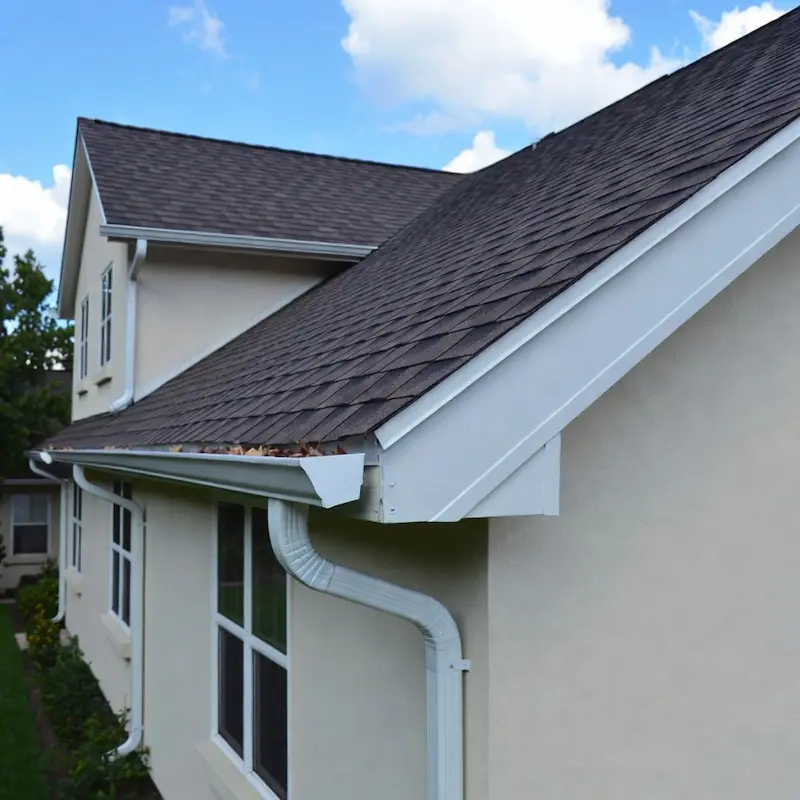
At the roofline, gutters prevent water from backing up beneath the first course of shingles and saturating the roof deck. Along the walls, they keep water moving away from siding, window frames, and door frames rather than running down exterior surfaces and finding entry points into the wall cavity. At the foundation, properly positioned and adequately sized downspouts discharge water far enough from the structure to prevent soil saturation and the hydrostatic pressure that contributes to foundation cracking and basement moisture. And at the landscaping level, a well-designed system keeps concentrated water discharge from eroding garden beds and topsoil along the building perimeter.
In the Marietta area, where annual rainfall averages well above the national average and where summer thunderstorms can deliver intense bursts of water in very short time windows, the demands placed on a gutter system are significant. A system that was designed with sufficient capacity, installed with proper pitch and hanger spacing, and fitted with adequately sized downspouts in the right locations will handle those demands reliably year after year.
Gutter Material Options
Choosing the right gutter material is one of the most important decisions in a new installation. Each option has a distinct set of characteristics that make it the right choice for certain homes and situations.
Copper Gutters
Copper is the premium choice for homeowners who want a gutter system that combines exceptional longevity, distinctive beauty, and outstanding performance. Copper gutters develop a natural patina over time that transitions from bright metallic to a warm brown and eventually to the characteristic verdigris green that many homeowners prize for its visual character. Properly installed copper gutters can last 50 years or more with appropriate maintenance and are highly resistant to corrosion in the humid North Georgia climate. Copper is an excellent choice for historic homes, high-end custom construction, and any property where the gutter system is a visible architectural element. The material cost is higher than other options, but the lifespan and aesthetic value make it a compelling long-term investment for the right property.
Galvanized Steel Gutters
Galvanized steel gutters offer excellent strength and rigidity at a more accessible price point than copper. The zinc coating that gives galvanized steel its corrosion resistance is highly effective, though it does require periodic maintenance to address any areas where the coating has worn through or been scratched, as bare steel will rust when exposed to moisture. Galvanized gutters handle the weight of debris and ice loading very well due to their structural strength, making them a practical choice for homes with heavy tree coverage or in areas prone to occasional winter ice accumulation. With proper care including periodic painting or coating, galvanized steel gutters can provide many years of reliable service.
PVC Gutters
PVC gutters offer a lightweight, rust-proof, and budget-friendly option that performs well in moderate conditions. Because PVC does not corrode or rust, it is inherently resistant to the moisture-driven deterioration that affects metal gutters over time. PVC is also easy to work with and is available in a range of colors that do not require painting. The primary considerations with PVC in the Georgia climate involve thermal expansion and contraction. PVC expands and contracts more significantly with temperature changes than metal options, which must be accounted for during installation to prevent joint stress and sag over time. PVC is a practical and cost-effective choice for many residential applications, particularly on single-story homes or structures where the aesthetic of the gutter material is less of a priority.
Seamless Metal Gutters
Seamless gutters represent the most popular choice for residential gutter installation today, and for good reason. Formed from a continuous roll of metal, typically aluminum, seamless gutters have no mid-run joints along the gutter trough. Because joints are the most common site for leaks in sectional gutter systems, eliminating them significantly reduces the maintenance requirements and leak risk of the installed system. Seamless aluminum gutters are lightweight, rust-resistant, available in a wide range of colors, and can be formed on-site to any length needed to match the exact dimensions of your roofline. They represent an excellent balance of performance, longevity, appearance, and cost for the majority of residential installations in the Marietta area.
Wood Gutters
Wood gutters are a specialty option most appropriate for historic homes, craftsman-style architecture, and restoration projects where authenticity of materials is a priority. Typically milled from old-growth redwood, cedar, or Douglas fir, wood gutters have a warmth and character that no manufactured material replicates. They require more maintenance than metal or PVC options, including periodic linseed oil treatment or painting to prevent moisture absorption and rot, and they must be kept clean to prevent debris from retaining moisture against the wood surface. For the right home and the right owner, wood gutters are an extraordinary feature that adds both historical integrity and visual distinction to the property.
Our Gutter Installation Process, Step by Step
A quality gutter installation is a multi-stage process that requires careful planning, precise execution, and thorough follow-through. Here is a detailed walkthrough of exactly how we approach every installation from the first conversation to the final flow test.
Step 1: Initial Inquiry and Project Discussion
Everything begins when you fill out our contact form and describe your project. You might be replacing a deteriorated system that is beyond repair, installing gutters on a home that currently has none, adding gutters to a new construction or addition, or simply upgrading to a different material that better fits your home’s aesthetic or your performance expectations. Whatever the case, the information you provide in the form helps our team prepare for the conversation that follows. A team member will reach out to ask any clarifying questions and gather additional details before scheduling the on-site assessment.
Step 2: On-Site Measurement and Assessment
The on-site visit is the foundation of a successful installation. During this visit our team conducts a complete assessment of your roofline, eave configuration, and existing drainage situation. We measure the linear footage of every gutter run, note the locations of valleys and high-volume drainage points on the roof, assess the pitch and orientation of each roof plane, and evaluate the condition of the fascia boards that the new gutters will be attached to.
Fascia condition is particularly important at this stage. Gutters are only as secure as the wood they are fastened to, and installing a new gutter system into deteriorated fascia is a setup for early failure. If we find fascia damage during the assessment, we bring it to your attention and discuss options for addressing it before or alongside the installation.
We also evaluate where downspouts should be positioned to provide the most efficient drainage. Downspout placement is not simply a matter of convenience or appearance. It is a drainage engineering decision that considers where water volume is highest along the roofline, where it can be safely discharged at ground level without creating pooling near the foundation or in low-lying areas of the yard, and how many downspouts are needed to handle the volume of water the roof sheds during heavy rain events.
Step 3: Material Selection and System Design
Once measurements are complete, we present you with a clear picture of your system design options and walk you through the material choices available for your project. We discuss the real-world advantages and considerations of each material in the context of your specific property and your priorities. This is a collaborative conversation, not a sales presentation. The goal is to make sure you understand what you are choosing and why it is the right fit for your home.
For homes with a significant tree canopy nearby, certain materials hold up to debris loading and moisture exposure better than others. For historically styled homes, material and profile aesthetics matter in addition to pure performance. For homeowners who want a low-maintenance system, material selection plays a major role in how much attention the gutters will need over their lifetime. We factor all of these considerations into our recommendations.
Step 4: Material Preparation and Cutting
With material selection confirmed and measurements finalized, we prepare the gutter sections for installation. For seamless gutters, sections are formed on-site using a portable roll-forming machine that produces continuous lengths of gutter with no mid-run seams. This eliminates the joint locations that are most prone to leaking in sectional systems and is one of the primary reasons seamless gutters have become the most widely installed option for residential applications.
For sectional materials like PVC, copper, galvanized, and wood, sections are cut precisely to the measured lengths and prepared for assembly. Mitered corners are cut at the correct angles to match the geometry of your roofline corners. End caps, outlet holes for downspouts, and any custom fabrication required for unusual roofline configurations are completed before sections go up on the wall.
Step 5: Fascia Preparation and Hanger Installation
Before the gutter sections are hung, we prepare the fascia surface and install the hanger hardware. Any minor debris, flaking paint, or surface material at the attachment points is cleared away to ensure solid contact between the hanger and the fascia. Hangers are positioned at intervals appropriate for the gutter material being installed. Heavier materials like copper and some seamless metals may require closer hanger spacing than lighter materials to support the additional weight. Fasteners are selected based on the fascia material and driven to the correct depth to achieve maximum holding strength without damaging the wood.
We pay particular attention to corners, end points, and the areas immediately adjacent to downspout outlets, which bear the most stress during high-volume rain events and require secure, properly positioned hardware.
Step 6: Gutter Section Installation and Alignment
With hangers in place, gutter sections are lifted and secured into the hanger hardware along each run. As each section is installed, we check and confirm the pitch using a level, adjusting hanger positions as needed to maintain the correct slope throughout the run. The target pitch carries water consistently toward the downspout outlet without creating low spots where water will pool between rain events.
On runs with multiple sections, each joint is carefully assembled and sealed from the inside with high-quality gutter sealant to create a watertight connection. End caps are installed and sealed at the termination points of each run. Mitered corners are fitted, sealed, and checked for alignment before the adjacent sections are hung.
Throughout this stage the crew works methodically around the perimeter of the home, completing one run fully before moving to the next and checking pitch and alignment continuously rather than leaving adjustments until the end.
Step 7: Downspout Installation and Connection
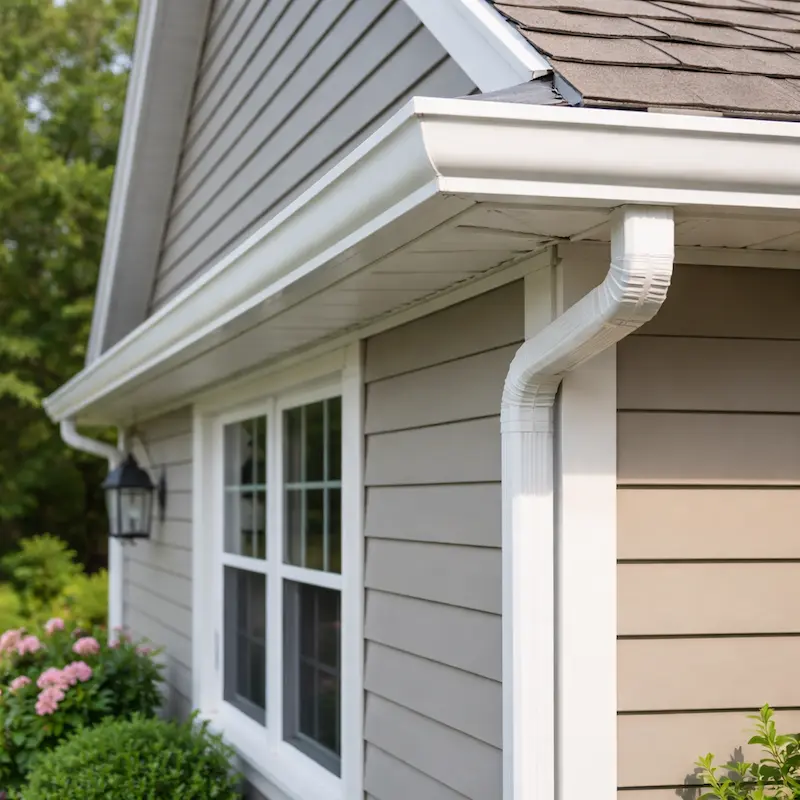
With the gutter troughs installed and aligned, we turn to the downspout installation. Outlet tubes are fitted into the holes cut in the gutter trough at each downspout location and sealed securely. Drop outlets connect the gutter trough to the first section of the downspout, which runs vertically down the exterior wall to grade level. Downspout sections are connected and secured to the wall using mounting straps at appropriate intervals to prevent the downspout from flexing, vibrating, or pulling away from the wall surface under water load.
At the base of each downspout, an elbow directs water away from the foundation. Where additional distance is needed to move water away from the structure, downspout extensions are fitted to carry water to a safe discharge point. For properties with underground drainage connections, the downspout is connected appropriately to the inlet at grade.
Step 8: Full System Flow Test and Final Inspection
With the complete system installed, we conduct a comprehensive flow test before the job is considered finished. Water is introduced at multiple points along the roofline and the crew observes the complete flow path of each gutter run, watching for consistent movement toward the downspout without pooling, watertight performance at every joint and end cap, full throughput at every downspout outlet, secure and stable performance of all installed hardware, and clean water exit at every downspout base directed away from the foundation.
Any issue identified during the flow test is corrected on the spot before we move on. After the flow test is complete and everything is confirmed to be performing correctly, we conduct a final visual inspection of the entire installation, clean up all material scraps and packaging from the work area, and walk you through the completed system with a clear explanation of what was installed and how to maintain it going forward.
Frequently Asked Questions
How much does gutter installation cost in Marietta?
Gutter installation costs in the Marietta area depend on several variables that are specific to your property. The primary factors include the total linear footage of guttering required to cover your roofline, the number of stories on your home, the material you select, the number of downspouts needed to drain the system adequately, and the complexity of your roofline. A straightforward single-story home with a simple roofline will cost considerably less than a two-story home with multiple valleys, dormers, and a large perimeter. Material choice also plays a significant role, with seamless aluminum typically representing the most accessible price point and copper sitting at the premium end of the range. The only way to get an accurate figure for your specific home is to fill out our estimate form. There is no charge and no obligation involved in requesting a quote.
How do I know whether I need a full replacement or if my existing gutters can be repaired?
This is a judgment call that depends on the age of your current system, the extent and distribution of the damage present, and whether the problems are isolated or systemic. Gutters that are leaking at one or two joints or have a handful of failed hangers are generally good candidates for repair. Systems that are showing widespread corrosion, multiple failing sections, persistent separation from the fascia at several points, or that are simply very old and have been repaired repeatedly are often better served by a full replacement. A new system installed correctly will outperform a heavily patched older one and will typically require less maintenance over the years that follow. During our on-site assessment we give you an honest evaluation of both paths so you can decide what makes the most sense for your situation.
What gutter material is best suited for homes in the Marietta area?
For most residential properties in Marietta and the surrounding Cobb County area, seamless aluminum is the most practical and popular choice. It is rust-resistant, lightweight, available in a wide range of colors to complement your home’s exterior, and can be formed on-site to match your exact roofline dimensions without mid-run seams. That said, the best material for your home depends on more than just performance. Homeowners in established historic neighborhoods near the Marietta Square or in areas with distinctive architectural character sometimes prefer copper for its longevity and visual distinction. Properties with craftsman or bungalow styling may benefit from the authenticity of wood gutters. Homes in more heavily wooded settings where debris loading is intense may favor the structural rigidity of galvanized steel. We discuss all of these considerations with you during the assessment so the material recommendation is based on your specific home and priorities.
How long does a gutter installation take?
For most single-family homes in the Marietta area, a complete gutter installation can typically be completed in a single day. The actual duration depends on the size of the home, the complexity of the roofline, the material being installed, and whether any preparatory work such as fascia repair is needed before the gutters can be hung. Larger homes with intricate rooflines or multi-story configurations naturally take longer. We give you a realistic time estimate during the assessment phase so you know what to plan for before the installation date arrives.
Do I need to be home during the gutter installation?
You do not need to be present throughout the entire installation, but we do recommend being available at the beginning of the appointment so we can walk you through the planned approach and confirm any final decisions about downspout placement, color selection, or other details before work begins. Being available at the end of the job for the final walkthrough is also worthwhile so you can see the completed system, ask any questions you have, and understand how to maintain it going forward. For the duration of the installation itself, our crew works independently and does not require your involvement.
What size gutters does my home need?
Gutter sizing is determined by the drainage load that each section of roofline needs to handle during a heavy rain event. The key factors are the square footage of the roof area draining into each gutter run and the pitch of the roof, which affects how quickly water moves off the surface and into the gutter. Most residential homes in North Georgia are well served by five-inch gutters with standard three-by-four-inch downspouts, but larger homes, steeper roofs, and high-volume drainage points at roof valleys may require six-inch gutters and larger downspouts to prevent overflow during the intense afternoon thunderstorms that are common throughout the Marietta area from spring through fall. We calculate the appropriate sizing for each run during the measurement phase rather than defaulting to a single size across the entire home.
How many downspouts does my home need?
A common guideline used in the industry is one downspout for every 30 to 40 linear feet of gutter, but the right answer for your specific home depends on more than just linear footage. The roof pitch, the surface area draining into each run, the location of roof valleys that concentrate large volumes of water into a single point, and the practical options for safe water discharge at ground level all factor into downspout quantity and placement decisions. Underestimating downspout needs is one of the most common installation errors and results in gutters that overflow at the midpoints of runs during heavy rain even when they are perfectly clean. We size and position downspouts based on actual drainage calculations for your roofline.
Can new gutters be installed in winter or during wet seasons in Georgia?
Installation can proceed during most of Georgia’s winter months since North Georgia does not experience the extended hard freezes that make outdoor work impractical in more northern regions. Mild dry days during winter are entirely workable for installation. We do avoid installing in active rain, as wet fascia surfaces and wet gutter sections make proper sealant adhesion more difficult and create safety concerns for ladder work at height. We schedule installations during appropriate weather windows and communicate proactively if conditions require a schedule adjustment.
What maintenance will my new gutters need after installation?
All gutter materials benefit from regular cleaning to prevent debris accumulation that adds weight, retains moisture, and blocks drainage. The frequency of cleaning needed depends primarily on the tree coverage around your property. Beyond cleaning, the maintenance requirements vary by material. Seamless aluminum requires very little beyond periodic cleaning and occasional inspection of sealant at the end caps and outlet connections. Copper develops a natural patina that requires no treatment and actually improves its corrosion resistance over time. Galvanized steel benefits from periodic inspection for areas where the zinc coating has worn and touch-up painting or coating to prevent rust from developing at those points. PVC should be inspected periodically for joint stress and sag that can develop from thermal expansion over time. Wood gutters require the most active maintenance, including regular linseed oil treatment or repainting and prompt cleaning to prevent debris from sitting against the wood surface between rain events.
Let’s Get Started On Your New Gutter System!
Fill out our estimate form and let Marietta Gutter Company evaluate your home, walk you through your material options, and design a system that fits your roofline, your drainage needs, and your goals. No phone calls needed, no pressure, and no obligation to move forward until you are confident you have the right solution.